
- Home
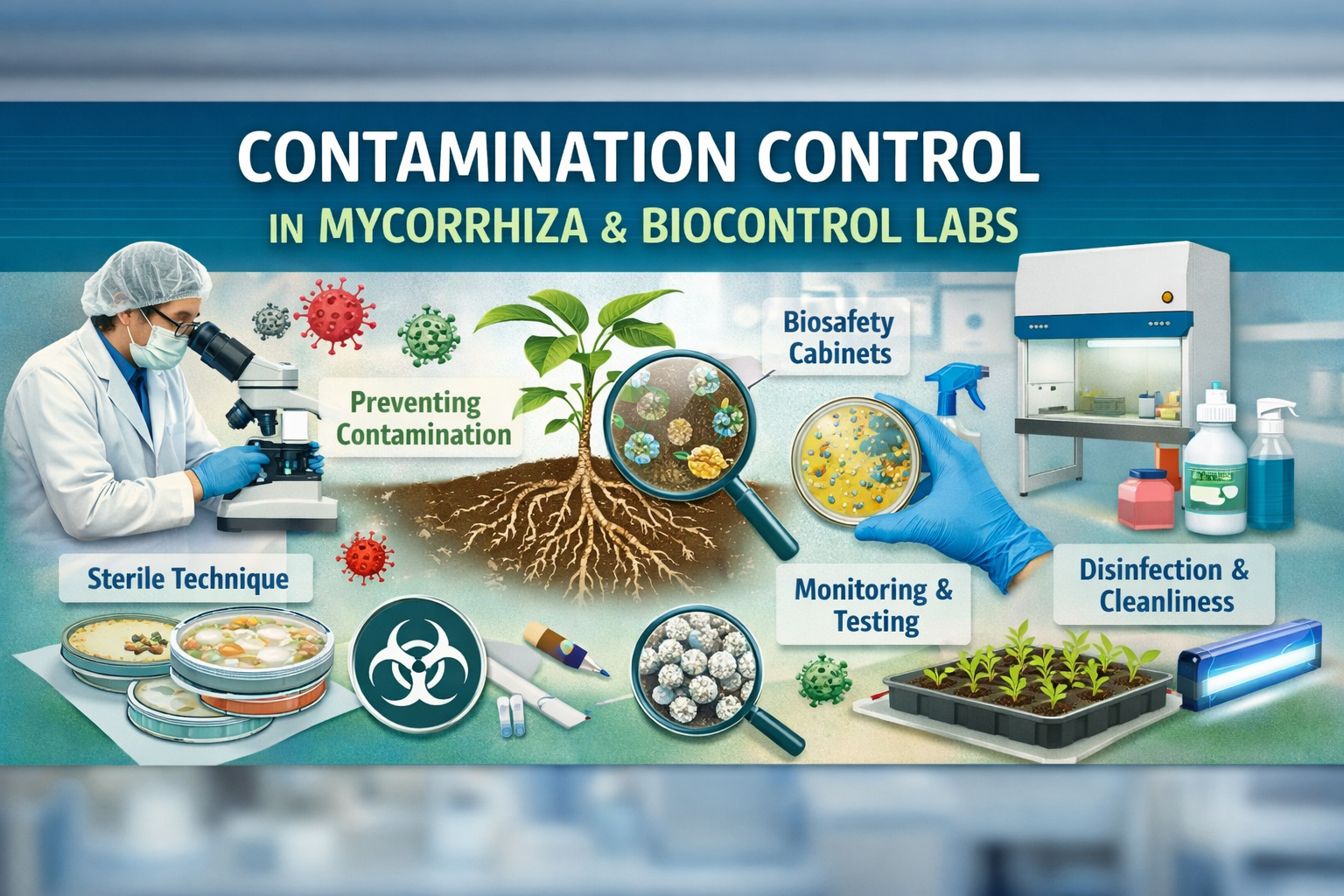
- Contamination Control in Microbiology/Biocontrol/Mycorrhiza Laboratories: How to Detect, Prevent, and Eliminate Bacteria, Fungi, and Spores

Aditi Bijalwan
Co-founder at Agrilogy Bioscience Private Limited
In the world of microbiology, biocontrol, and mycorrhiza research, the work is inherently invisible. We operate in realms measured in micrometers, dealing with microbial consortia, fungal hyphae, and bacterial antagonists. However, there is one invisible element that every lab technician dreads: contamination.
Whether you are isolating a novel biocontrol agent, maintaining a pure culture of Trichoderma, or trying to establish a sterile mycorrhiza association, contamination is the great equalizer. It wastes time, invalidates data, and costs significant money.
This post breaks down the sequence of control: from the daily wipe-down, to the deep clean, to the architectural design of clean rooms, with specific focus on Bacillus spores and cross-contamination risks unique to mixed-discipline labs.
1. Daily Cleanliness: The First Line of Defense
Daily cleaning is not just "tidying up." It is a deliberate act of reducing bioburden before it aerosolizes or transfers to your cultures.
Not all disinfectants are equal. The choice depends on the surface and the likely contaminant:
In microbiology, biocontrol, and mycorrhiza laboratories, disinfectant selection must be based on spectrum and limitations.
- 70% ethanol (IPA), prepared as 70% in water, is effective against vegetative bacteria and enveloped viruses, but it is not sporicidal and evaporates quickly, reducing effective contact time.
- Sodium hypochlorite (bleach) at 0.5% concentration (typically a 1:10 dilution) provides broad activity against bacteria, fungi, spores, and viruses; however, it is corrosive to metals and requires rinsing or proper removal after application.
- Quaternary ammonium compounds at 0.4–1.6% offer broad-spectrum disinfection with residual activity on surfaces, yet they are not effective against non-enveloped viruses or bacterial spores.
- Phenolic disinfectants, used as per manufacturer recommendations, maintain activity even in the presence of organic matter and provide broad-spectrum control, but they raise toxicity concerns and are unsuitable for food-contact surfaces.
Recommended Daily Routine
- Pre-clean: Remove visible dust, media spills, and debris with a dry wipe.
- Disinfect: Apply 70% IPA to work surfaces after physical cleaning. IPA requires a contact time of at least 30 seconds to kill—do not wipe dry immediately.
- Rotation: Use bleach or a quaternary salt once weekly to prevent the emergence of tolerant microbial populations.
Common Daily Mistakes That Welcome Contamination
- Spraying and wiping immediately: This reduces contact time. The microbe survives.
- Using dirty cloths: Reusable cotton cloths spread contamination. Use single-use low-lint wipes soaked in disinfectant.
- Cross-contaminating bottles: Dipping dirty sponges into disinfectant stock contaminates the entire bottle. Decant into a spray bottle; never "top up"—wash the bottle dry before refilling.
- Neglecting high-touch points: Door handles, faucets, refrigerator handles, pipette adjusters, and keyboard keys are frequently touched with gloved hands that have handled cultures. These are primary vectors for recurring mold contamination.
2. Washing of Vessels and Equipment: The Sterility Gateway
If glassware and plasticware are not properly processed, they become inoculation devices.
The Washing Protocol
- Immediate soaking: Do not allow media or agar to dry onto glassware. Soak in a mild detergent solution immediately after use.
- Brushing: Use a dedicated brush reserved only for labware. Brushes harbor moisture and microbes; autoclave them weekly.
- Detergent choice: Use liquids over powders to avoid abrasive scratching. Scratched glass traps organic matter and microbes, shielding them from autoclave steam.
- Rinsing: Rinse five times with tap water, followed by three rinses with distilled or RO water. Residual detergents inhibit microbial growth and can skew experimental results.
- Drying: Air-dry on sterile racks. Do not use cloth towels—they reintroduce lint and bacteria.
Equipment-Specific Risks
- Pipettes: Reusable glass pipettes must be placed in disinfectant immediately (horizontal) to ensure internal flooding. Autoclave before washing to prevent aerosolization of pathogens during cleaning.
- Bottles: Remove caps and wash separately. Hinge areas of screw caps trap dried media—scrub with a small brush.
- Magnetic stir bars: Often overlooked. They crack, and the inner steel core corrodes, creating microscopic channels thatharbor Bacillus spores. Inspect monthly; discard if cracked.
3. Clean Rooms and Laminar Flow: Architecture of Asepsis
A "clean room" or laminar airflow (LAF) cabinet is not merely a workspace—it is a controlled microenvironment.
Significance in Mycorrhizal and Biocontrol Labs
- Mycorrhizal fungi grow slowly (weeks). Fast-growing contaminants like Aspergillus and Penicillium will overgrow them entirely.
- Biocontrol agents (e.g., Trichoderma, Beauveria) are themselves sporulating fungi. They must be contained within the clean zone, not allowed to escape and contaminate other work.
Sources and Sinks of Contamination in Clean Rooms
Contamination in clean rooms and laminar airflow areas often originates from overlooked structural and operational weaknesses.
- A HEPA filter bypass occurs when air leaks around the filter edges instead of passing through it, allowing unfiltered air to enter; this risk is minimized through annual certification and ensuring that filter gaskets remain intact.
- Pre-filter neglect is another common issue, as coarse pre-filters trap large dust particles and, when clogged, reduce airflow and compromise room pressure—therefore, they should be cleaned or replaced monthly.
- Sink drains can harbor wet, nutrient-rich biofilms that aerosolize when water runs, making sinks undesirable in clean rooms; if unavoidable, they must be flushed with bleach weekly.
- Worn door seals permit unfiltered hallway air to enter, so maintaining positive pressure—where air flows outward when the door opens—is essential.
- Frequent staff entry and exit disrupts pressure differentials, necessitating limited traffic and the use of pass-through hatches.
- Finally, outdoor shoes introduce soil-borne spores into controlled environments, making dedicated lab footwear or sticky entry mats critical for contamination control.
The "Sink" Concept
A sink is any location where contaminants accumulate and amplify:
- Floor drains
- Mop buckets
- Humidifier reservoirs
- Water baths (the single largest reservoir of Pseudomonas in most labs)
Control: Remove sinks from critical areas. If impossible, automated chemical dosing systems are required for water baths and drains.
4. Deep Sanitization: Eradicating Bacillus Spores
Bacillus species (e.g., B. subtilis, B. cereus) are the ultimate test of a sanitation regime. They form endospores—dormant, heat-resistant, chemical-resistant structures that can survive boiling ethanol and years of desiccation.
Why Routine Cleaning Fails Against Spores?
- 70% ethanol does not kill spores.
- Quaternary ammonium compounds do not kill spores.
- Phenolics are ineffective against spores.
The Sporicidal Protocol
To eliminate Bacillus, you must use sporicidal agents with adequate contact time and mechanical action:
- Chlorine-based (Bleach):
- Concentration: 0.5% sodium hypochlorite (1:10 dilution of household bleach).
- Contact time: 10 minutes minimum. Do not wipe before 10 minutes.
- Limitation: Corrosive. Must be rinsed or neutralized on metal surfaces.
2. Hydrogen Peroxide (Accelerated):
- 6–7.5% hydrogen peroxide with stabilizers.
- Contact time: 20 minutes.
- Advantage: Breaks down to water and oxygen; non-corrosive.
3. Peracetic Acid:
- 0.2% solution.
- Contact time: 10 minutes.
- Use: Ideal for stainless steel and sealed equipment.
4. Chlorine Dioxide:
- Pre-mixed solutions.
- Effective at lower concentrations; less corrosive than bleach.
Procedural Note:
Spores are hydrophobic. A bleach droplet on a clean surface may bead up and fail to contact the spore. Use a wetting agent (a drop of detergent) or physically spread the solution with a sterile wipe to ensure contact.
5. Cross-Contamination and Pure Culture Handling
The Biocontrol Paradox
- Trichoderma, Beauveria, and Metarhizium produce millions of aerial spores per plate.
- These spores remain airborne for hours.
- Mycorrhizal cultures (e.g., Rhizophagus irregularis) require weeks to grow. A single Trichoderma spore landing on the medium will colonize it in 48 hours.
Pure Culture Handling: The Rules
1. Segregated Airspace
- Never open a sporulating biocontrol plate in the same room where you handle mycorrhizal cultures or pure bacterial cultures.
- If space is limited, schedule biocontrol work at the end of the day, then perform a terminal clean (bleach fogging or UV irradiation) before mycorrhizal work the next morning.
2.The "One-Hand" Technique
- Keep cultures capped/taped whenever possible.
- When removing a lid, tilt it like a "shield" over the plate—do not hold it directly above the open agar.
3. Sterile Glass Spreaders vs. Beads
- Reusable glass spreaders dipped in ethanol and flamed are common. However, if the ethanol is not absolute, the flame only ignites the vapor; the liquid ethanol (70%) does not reach sterilizing temperature on the glass. Result: You are spreading Bacillus spores across your plate.
- Solution: Use sterile disposable plastic spreaders, or ensure glass spreaders are autoclaved before use, not just flamed.
Contamination is rarely an act of God—it is an act of process failure. By dissecting your workflow, auditing your cleaning chemistry, and respecting the airborne nature of spores, you can transform your lab from a constant battle into a controlled, reproducible environment.
Comments (0)
No comments yet. Be the first to comment!


Leave a Comment